Two Books by Susan Landgraf
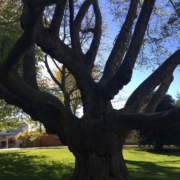
JOURNEY OF TREES, Susan Landgraf, The Poetry Box Publishing, 2024. Finalist for the 2023 Poetry Box Chapbook Prize.
THE INSPIRED POET: WRITING EXERCISES TO SPARK NEW WORK, Susan Landgraf, Two Sylvias Press, 2019.
In the words of Jane Wong, the poems in Journey of Trees are “fed by the kindling of myth and lyrical curiosity.” 
 Sati Mookherjee tells us the poems “show how we story-tell our way into truth-telling.” More proof that poetry is a good path for us to find ourselves on.
I purchased both of these books in June of 2024, right before my life began unraveling. They have waited patiently on my shelf for me to rediscover them, and National Poetry Month provides a perfect time to have done so.
The 37 exercises in The Inspired Poet include “Writing into Our Fears,” “Leaping Poetry,” “It’s a Piece of Cake,” acrostics, list poems, and “Thinking in Similes.” Each exercise offers example poems, for instance the simile-rich “Love Poem Without a Drop of Hyperbole in It,” from Traci Brimhall; the final poem in the book is Samuel Green’s brilliant “Some Reasons Why I Became a Poet.”
Landgraf is a long-time teacher of poetry and workshop leader herself, and, in short, this book is well worth your attention.
One poem from Journey of Trees—
The Ten Stations of Worship
This is the hand held for safety’s sake,
palms raised to show the most traveled paths.This is the foot, bunioned and mud-stained—Russian
steppes, ice caves, olive groves.This is the leg, striding or curved, lotus-like
in the California poppies.This is the eye of curled ferns and symbols.
This is the eye of permission. Amen.This is the lap, a nest of goose down.
We’ve learned to fold and to wait.This is the breast we come to and come to—
our need for suckle and beauty and grace.This is the seed pod moist
with rain.This is the other mouth
we depend on—the telling and retellingin this temple of trees.
—Susan Landgraf
I recently came across (again) the words of Wislawa Szymborska: “I prefer the absurdity of writing poems to the absurdity of not writing poems” (from her poem, “Possibilities”). I’ve been questioning why I wanted to do so many reviews in April (when I have plenty else to keep me busy), and why I over-indulged on Independent Bookstore Day and bought a bunch more poetry books. Szymborska helps me understand myself, and this quote, from the great Grace Paley, shared by Landgraf (p. 177), helps, too:
The best training is to read and write, no matter what. Don’t live with a lover or roommate who doesn’t respect your work. Don’t lie, [but] buy time, borrow to buy time. Write what will stop your breath if you don’t write.
(Interview from The Paris Review, 1992)
It’s not your obsession, Bethany, it’s your passion. (And such good company on the journey.)


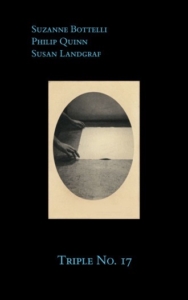 Bottelli’s “American Grubble.”