Posts

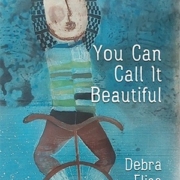
Debra Elisa: YOU CAN CALL IT BEAUTIFUL

YOU CAN CALL IT BEAUTIFUL, Debra Elisa. MoonPath Press, PO Box 445, Tillamook, OR 97141, 2023, 107 pages, $17.99 paper, http://MoonPathPress.com.

I’m enthralled by this book of poems by Oregon poet Debra Elisa. My first impression was that her poems made a good contrast to mine, choreographed differently, her language distinct and pocked with color. But as I read more deeply, I began to see how our subjects and themes overlap: childhood songs, mothers and grandmothers, kitchens, birds, dogs, backyard gardens.

We also—if I can extend my interests beyond my new book—share a fascination with Emily Dickinson, as this cover blurb written by Allen Braden makes clear, calling Debra’s style “as idiosyncratic as Emily Dickinson’s with poems flaunting ‘breath and tiptoe glory and Clover.’”

And so much more, poems about social justice, poems about peace. Consider these lines:

You write often of    Trees   Dogs   Birds
she says       and I feel disappointed      because I wish

her to tell me       You challenge us to consider justice
and love in all sorts of ways.

(“Dear Friend”)

In short, this is an eclectic, surprising collection of poems.

What makes You Can Call It Beautiful a coherent collection (too) is the way Debra weaves her themes throughout, and unites all of it with her gift for sound and color. In “On the Way to Khajuraho” we encounter “Saris of aubergine    azure    black ayayas,” ending with “Ginger    and     Sunrise // charging again / this peregrine Land.” Having traveled so little myself, I’m both in awe of Debra, and grateful for her generous, joyful evocations.

Ekphrastic poetry—poetry about art—is another thread. This poem, quoted in full, evokes the cover art. At the same time it demonstrates the motif of elegy that twines all the way through the book:

Boy on Bicycle

            after Graciela Rodo Boulanger’s
            Le vainqueur (The Winner), etching, 1968

One painting
on the living room wall
the boy pedals
grin and play
pastel blues
celadon
was gift to you
then left
to me

when I asked
for this delight to hang
in my own home.

The others—charcoal
and sketch    a single brushstroke
acrylic eyes    another crimson
your creations
beginnings and conversation
we continue.

Your portrait—slight smile
glance to camera—
set on my desk
another on a kitchen shelf.

You left us early

and some stories
you believed
were never
true.

—Debra Elisa

Debra’s book is available from MoonPath Press, from https://bookshop.org, and from your local independent bookseller. You can read another poem by Debra at MoonPath on her author page, and you can read her blog, here: https://www.l-i-t.org/author/debelisa/
Sally Albiso Poetry Book Award

My poetry manuscript — The Pear Tree: Elegy for a Farm — has won the 2023 Sally Albiso Poetry Award from MoonPath Press.

I’m feeling stunned and honored and — even after a week has gone by — a bit disbelieving.
I’ve shared here some of my process in cobbling this book together, but just to recap, it’s the book that wouldn’t lie down and be “done.” Three years ago in a Hugo House course taught by Deborah Woodard, I rather shamefacedly introduced myself by saying I was working on a book of poems about losing my parents, adding, “I really should be finished with these poems.”

Deborah said, “Maybe the poems aren’t finished with you.”

That is exactly what it felt like. It’s about more than my mother and father; it’s about growing up on a farm, and it’s about giving up that farm after my dad’s death in 2010. It’s about letting go of trees, fields, cows, fences, wells, ponds, bee boxes, books, orchard trees, creeks, barns… It’s about my mother’s memory loss, and how keenly that paralleled our folding away the family place, the farm my grandfather had owned before my father owned it. It’s about…so much.

Last year I began sending the manuscript out as “Genesis” (meaning to evoke an idea of where I began, where I set out from), and despite having paid some hefty entrance fees, I withdrew it. Early this year I began sending it out again, rearranged, with poems added (and quite a few removed), with a stronger theme, or thread, poems about my maternal grandmother, running all the way through, holding — I hoped — the long chronology together.

In May I reworked it yet again, and it was only then that I felt brave enough to retitle it as The Pear Tree.

I could not have been more shocked when it won. Lana Hechtman Ayers wrote in an email, “These are poems to feed the soul.”

They have certainly fed mine.

The book will be out this winter, and, never fear, I will be here, telling you all about it.


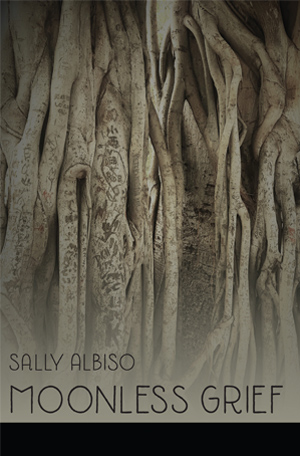
Sally Albiso, Moonless Grief

MOONLESS GRIEF, Sally Albiso. MoonPath Press, PO Box 445, Tillamook, OR 97141, 2018, 74 pages $15 paper, http://moonpathpress.com.

It was my pleasure to read Sally Albiso’s Moonless Grief this morning. A lovely book that—perhaps because of Albiso’s untimely death in 2019—feels like a collection of elegies, or love songs for life.

The poems flutter with wings, cormorants, eagles, sometimes wings of angels. Wings are observed, and metaphorical. “Kingfishers kite with a nervous energy like yours,” a thrush slams into a window, and we get these evocative lines: “I cradle the bird the way some people pray / but take only silence into my hands” (“Compass”).

And this:

A hibernating bird,
its flock called an addiction
as if flight becomes sleep,
becomes craving
only a season of torpor relieves,
and loss just a word
like winter.

(from “Storm”)

Here’s a short poem, that will maybe demonstrate why I’m swooning:

Nest

A conical shape concealed
among loops of rope
hanging from a cedar bough.
A shelter of lichen and moss
lined with feathers so soft
I want to peck my way through a shell
and curl inside such refuge.
This way station between hatching
and flight more forgiving
than immediate delivery,
a secondary womb that secludes
until air gives life. How it would feel
to wake to that mercy and suspend
among cushioned walls
even after the last umbilical scab
falls away. To linger there
until able to take in light
without squinting,
breathe without crying first.

—Sally Albiso

You can read Albiso’s poem “Wildfire” at Verse Daily, and “When You Visit,” at MoonPath Press, plus Albiso’s brief biography and legacy.

Photo by Miriam Fischer


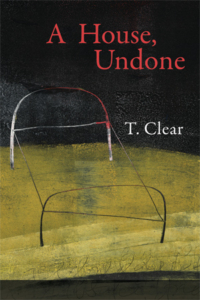
T. Clear: A House, Undone

A HOUSE, UNDONE, T. Clear. MoonPath Press, PO Box 445, Tillamook, OR 97141, 2022, 86 pages, $16.00 paper, http://MoonPathPress.com.

What a pleasure to read this book this morning!

“Pleasure” seems a less than adequate word as the topics of some of these poems drift far from the pleasurable. Unexpected deaths, lawsuits, houses slipping from foundations. Bird nests, dismantled. A beloved’s clothes trundled off to Good Will. Squalor of a homeless camp. Even so, in every poem we find the glitter of well-chosen words. The trajectory of the poems pulls a life together, lining up events like laundry on a clothesline: “ice brittled in every empty pocket.”

Kelli Russell Agodon, from the back cover: “A House, Undone becomes the beautiful architecture for poetry, where we live in a house of words on ‘a bed littered with leaves, / starlight for a roof.’” And Jed Meyers: “These poems turn personal loss and uprootedness into a highly contagious empathy for those whose dwellings we couldn’t call houses.”

I’m amazed by how the poet makes everything fit here. It’s biography (three sections: childhood, marriage, after) but settling in alongside the biography are two poems written in Ireland, a poem about cheese (“Autobiography of Cheese”!), beekeeping poems. I had to go back and reread just to figure out how Clear carries it off so convincingly. Maybe it’s the way house/home is always lurking around the lines: “a stone cottage hunkers / in decay, vulnerable to stars”; “let me be small enough to enter a honeyed hive / …fold myself, shoulder to shoulder, / into the sweet company of their cluster.”

I’d love to share a dozen poems, but I’ll settle for the first poem in the collection, which opens the door and invites us in:

Life Sentence

I live in a house of scant beginnings,
of rupture and leakage,

splinter and rot. A wire
dangles to nowhere, something

cut mid-sentence, a thought
that will never complete itself.

A house of raveling sweaters
and unpainted stairwells.

Crack in the glass, hemless curtain,
the last bit of aluminum foil

flattened and folded one more time.
Awaiting the phone call, the letter,

a knock at the window,
crow at the door—

here lie all my unfinished cadenzas,
my abrupted couplets.

—T. Clear

I always read the acknowledgments — “Gratitude,” here — and was so tickled to find a tribute to Professor Nelson Bentley:

…under whose tutelage I learned that one can be a poet and live a perfectly ordinary life. (Although “ordinary” is a slippery word, open to myriad interpretations.) His generous spirit, his sense of humor, and his inclusive community of poets profoundly shaped how my next forty years of “poeting” would play out.

A House, Undone shares that generous spirit. It won MoonPath’s 2021 Sally Albiso award, and you can read more about it here.